
Work / 06
Sports data · Gravity racing
OnSprint
Race intelligence for gravity racing
- Client
- OnSprint (our own product)
- Years
- 2025–2026
- Role
- Founder: product, design and engineering

OnSprint turns official race timing into rider-level sector data, then uses it to rate riders, review how fair a race was and simulate results. It started with the racers we coached and now covers whole gravity-racing series for racers and promoters alike.
Context
OnSprint began as a coaching tool. Our founder coaches downhill racers, and after every race the same question came up: where exactly was the time lost, and against whom? The answer was in the split times, but they are published as ChronoRace, UCI and regional timing PDFs, so comparing a rider’s sectors across a season meant copying numbers by hand.
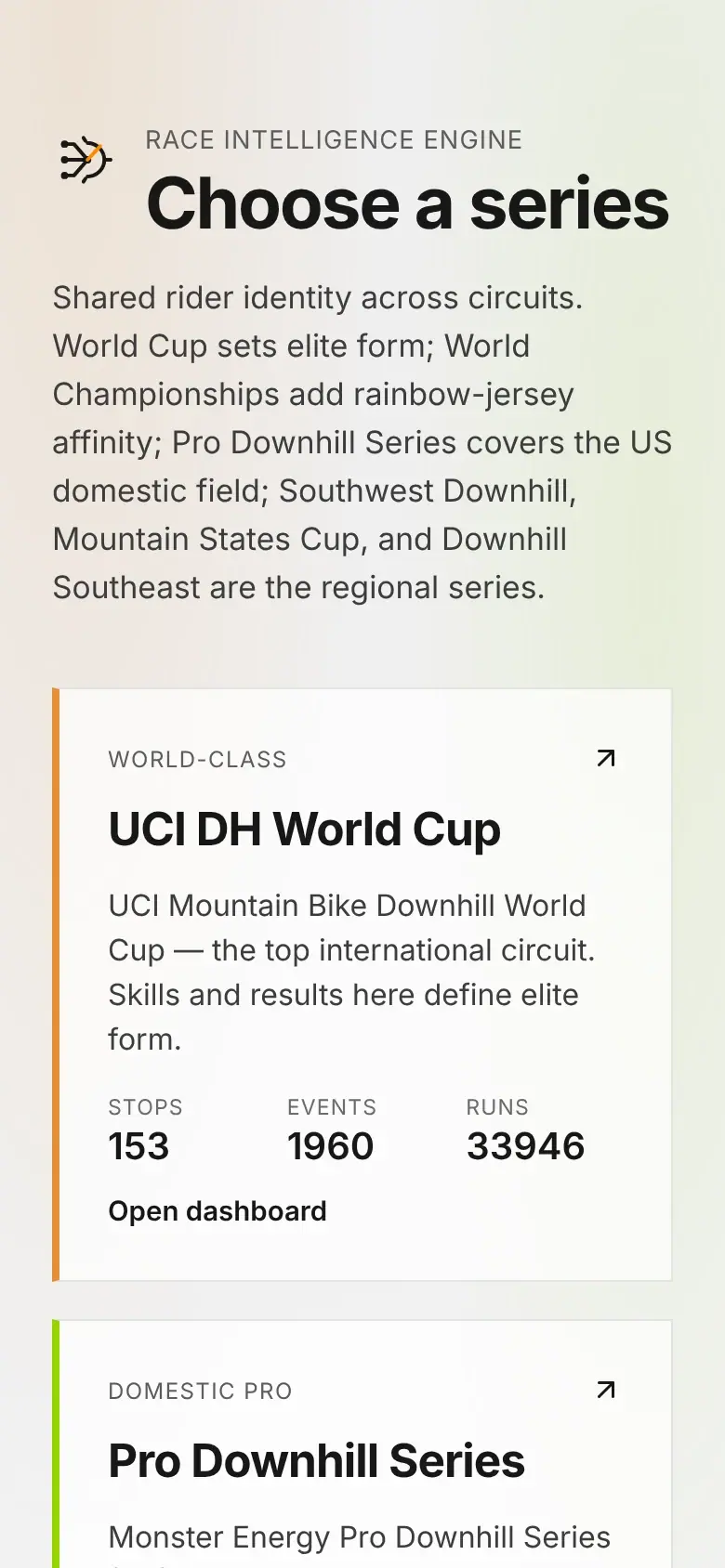
We built the first version for the racers we coached. It worked well enough that we made it generic: the same engine now reads full Grand Prix-style series, from the UCI Downhill World Cup and World Championships to the US Pro Downhill Series and regional series such as Southwest Downhill, Mountain States Cup and Downhill Southeast. It is built for every racer in the field, and for the promoters who run the events.
What we built
- A parsing pipeline that runs whenever a results PDF lands in storage, built on Firebase Functions, with a source queue and a local pipeline for bulk imports
- Racers, Races, Venues and Compare views for sector-by-sector analysis, with rider history, venue profiles and head-to-head comparison
- Rider ratings in the spirit of Elo: a career skill rating built from head-to-head results, combined with form, momentum, venue fit and consistency
- Race simulation: a seeded Monte Carlo model that gives each rider a probability to win, make the podium or the top 10, and a likely range of places, including the World Cup Q1/Q2 qualifying format
- RaceQA, a fairness review for promoters: catch-risk from start lists and seeding, and whether sector anomalies concentrate on part of the field, with a shareable report
- Rider reports that flag mistake sectors and estimate the time each one cost
How it works
The hard part was not the interface. It was making messy, inconsistent source documents reliable enough to compare: duplicate ingests, wrong event dates, sectors that do not add up. Every run is cleaned, every sector is scored against the field with robust statistics, and one crash sector cannot wreck an otherwise fast run.
The prediction model is tuned on past seasons and tested on races it has never seen, against a simple “last result” baseline. We publish what it can and cannot do: it is useful for shortlists and likely ranges, not for calling exact places, because crashes and weather still decide races.
Nothing in the engine is specific to downhill. Anything raced against the clock in sectors (enduro, downhill, and other timed gravity events) fits the same model of runs, sectors, riders and venues.


Next case study
ChronoCultRace timing without the timing truck →Have a product at a similar stage?
Book a call