
Work / 13
Video games · Racing
Midnight Club
A new standard for racing game interfaces
- Client
- Rockstar Games
- Years
- 2005–2008
- Role
- UI Lead
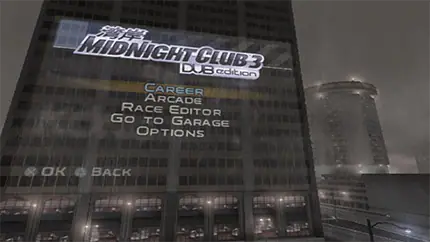
Rockstar Games have a unique vibe with their games. They have a strong movie influence. They want their games to feel as engaging and immersive as watching a flick in a movie theater. Our founder, Jerome Lacote, joined the team as UI Lead when Rockstar Games took over the Midnight Club car racing franchise with the mission to create a more immersive experience.
Context
Rockstar Games have a unique vibe with their games. They have a strong movie influence. They want their games to feel as engaging and immersive as watching a flick in a movie theater. Our founder, Jerome Lacote, joined the team as UI Lead when Rockstar Games took over the Midnight Club car racing franchise with the mission to create a more immersive experience.
Process
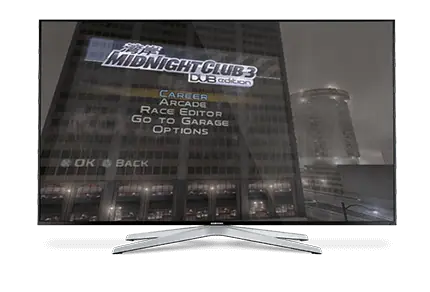
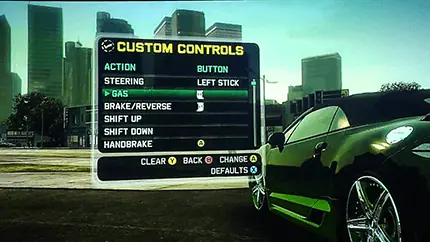
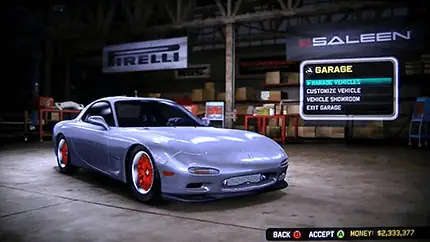
For Rockstar’s first foray in this franchise on PS2, he decided to avoid the 2D screens that would disrupt the user immersion in the environment. He then opted to display the frontend menus as if they were projected on some buildings in the city, it worked particularly well because the action always happens at night in the game (it's an underground street racing game that takes place in different cities). He had to create some camera animation to transition from any places in the city to the frontend projection site. After the success of this approach, the team worked on new sequels of the game on more powerful "next-gen" consoles (PS3, Xbox 360), it gave the team the opportunity to afford more resources for UI. The team went all in and decided to implement a seamless experience. The user never quits the city, there are no cuts, the camera always travels in the environment from one view to the other. All the menu elements are positioned in the 3d environment. The team created floating menus that would be able to be displayed at anytime, anywhere in the city. The team spent a lot of time and resources to make sure the camera framing and the menu behavior would be perfect. He had to consider all kinds of special cases to avoid menus to collide with other 3d models. The team treated the UI as a real character in the game.
Results
The final result is stellar. The player feels a real sense of immersion and the engagement was greatly improved. The game has a movie feel with a real continuity. This approach has been so successful that it has been used over and over by most games in this genre. (Drift, Blur, Need for Speed, etc.)
Next case study
TransfyrFrom prototype to a production science platform →Have a product at a similar stage?
Book a call